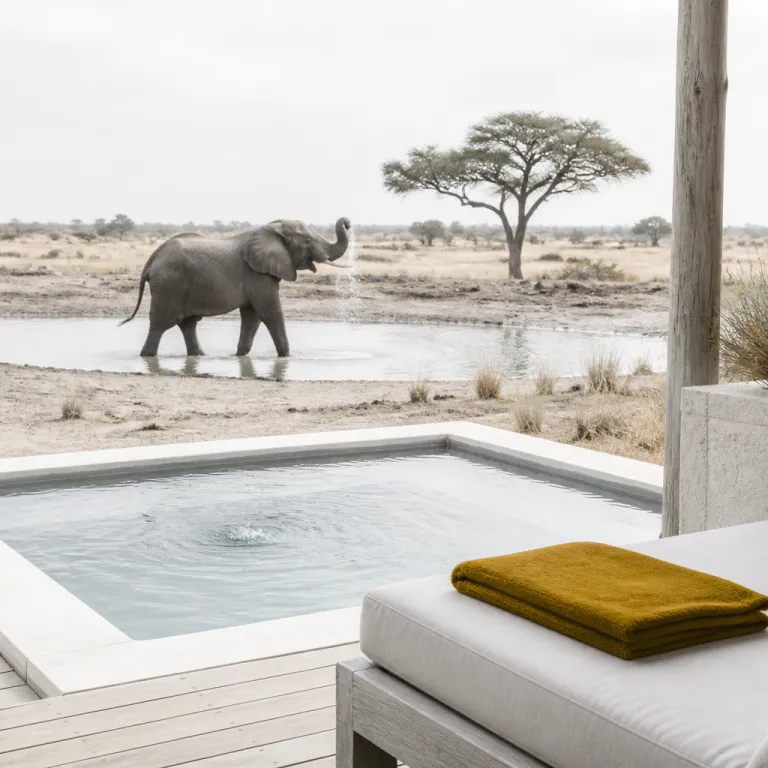
The private plunge pool paradox at the waterhole
A safari camp where your private plunge pool faces a busy watering hole changes how you think about seclusion. You slip into the cool water, feel entirely hidden, and then realise the real audience is the wildlife lining up at the reserve’s most reliable drink. It is a curious paradox: the pool belongs to you alone, yet every movement is quietly observed from the bush.
Across southern Africa, a new generation of safari lodges positions each private pool or series of plunge pools directly opposite a natural or pumped waterhole. The aim is simple: to turn passive game viewing into an immersive ritual, where elephants, zebra and sometimes predators drift into frame while you float in your own small sanctuary. Luxury here is not only about deep suites, high thread counts and flawless service, but about how precisely each camp is situated in relation to wildlife corridors and seasonal water.
Properties such as Etali Safari Lodge in Madikwe Game Reserve and King’s Pool Camp in Botswana’s Linyanti region show how carefully this placement is planned. Their teams study game patterns, prevailing winds and the lie of the land before deciding where each viewing deck, private deck and pool should sit. At Etali, for instance, suites are set back from the main waterhole to keep animals relaxed while still offering clear views, while at King’s Pool the lagoon-facing plunge pools are raised above the floodplain. As one Madikwe lodge manager notes in guest briefings, “we design from the animals’ perspective first, and then fit the suites around that logic.” The result is a string of suites where the pool becomes a front row seat to the waterhole, rather than a decorative amenity hidden behind the main lodge.
How camps position pools for wildlife and waterhole drama
When a safari lodge promises a private pool with waterhole views, the best ones mean it literally. Architects map the terrain so that each suite is situated on a slight rise, giving your plunge pool a clear line of sight to the water without disturbing the wildlife. In the most thoughtful properties, the main lodge steps back, letting the private game spectacle unfold between your terrace and the bush.
In South Africa and across wider southern Africa, this often means building low impact decks that hug the contours of the land. At Etali Safari Lodge, for example, suites with plunge pools are angled so that animals approach the waterhole without crossing human paths, which keeps both wildlife and guests calm. King’s Pool Camp in Botswana uses elevated walkways and a generous viewing deck system, allowing you to move between the main pool, your private plunge pool and the water’s edge while remaining safely above the game.
New openings follow the same logic, from JW Marriott’s Mount Kenya Rhino Reserve Safari Camp to Banyan Tree Ubuyu in Ruaha National Park. Both projects focus on placing each private deck and plunge pool where wildlife naturally funnels towards water, rather than forcing animals to adjust to the camp. A senior designer on the Mount Kenya project has described the process as “starting with the elephants and only then deciding where the humans go,” a line that neatly captures the philosophy behind these layouts. If you plan to reserve one of these suites, enquire specifically about how close your pool will be to the waterhole and whether any other pools or tents overlook your space, because genuine privacy is as important as the view.
For travellers used to European countryside retreats, the planning process is similar to choosing a secluded pool suite in Norfolk or the Lake District, where orientation and screening matter as much as the pool itself. The same mindset applies in the bush, only here the neighbours are elephants and antelope rather than other guests, and the view is a waterhole instead of a walled garden. When you look at lodge photo galleries or virtual tours, treat them as you would hotel images at home: zoom in on how the pool faces the landscape, what sits between you and the horizon and whether any other structures intrude on that line of sight.
Dawn, dusk and the rhythm of waterhole game viewing
Time of day matters when your waterhole-facing plunge pool is the main event. Dawn brings the first soft light, when nocturnal species retreat and diurnal game edges towards the water, often while you are still wrapped in a robe on your private deck. Many guests choose to skip one game drive during a stay, lingering in their pool instead to watch the bush wake up in real time.
By late morning, heat builds across Africa and the waterhole becomes a social stage for plains game, while predators melt into shade. This is when a shaded private pool or a series of plunge pools comes into its own, letting you cool off between sightings without leaving your viewing deck. Camps in South Africa’s Madikwe and in Botswana’s Linyanti often design their pools with generous ledges, so you can sit half submerged, binoculars in hand, as giraffe and kudu file past.
Dusk is different again, with a golden hour that flatters both wildlife and water. As the sun drops, elephants often return for a final drink, and the reflection of their silhouettes in your plunge pool can feel almost cinematic. If you are travelling with children, this is usually the most magical time for them, though you should always check each safari lodge policy on minimum children age and whether children are allowed in private pools without a guardian present.
For travellers who obsess over pool stays in every context, it helps to apply the same selection discipline you would use when choosing exceptional hotels with private pools near home. You are still weighing orientation, privacy, noise and access, only now you add game viewing patterns, waterhole proximity and the timing of animal movements to your checklist. A quick conversation with a lodge reservations team can reveal when their waterhole is busiest, which side of the camp catches sunrise or sunset and whether your preferred suite lines up with those rhythms.
Sound, silence and the open air pool experience
The soundscape is what separates a generic private pool from a true open air safari setting. Pools without enclosing walls let the bush soundtrack flow in; you hear francolins, distant lion calls and the low rumble of elephants approaching the waterhole long before you see them. In contrast, more enclosed terraces can mute these details, trading acoustic immersion for a stronger sense of physical security.
At camps like Jack’s Camp on the edge of Botswana’s Makgadikgadi Pans, designers lean into the vast silence, so that every splash in your plunge pool feels amplified against the stillness. River lodge properties along major waterways, whether near Victoria Falls or in parts of southern Africa’s great river systems, add another layer with constant water noise beneath the wildlife chorus. When you reserve a suite, ask whether your private plunge pool is fully open to the bush or partially walled, because this will shape both what you hear and how exposed you feel.
Some safari lodges in South Africa’s Sabi Sand and the broader Sabi Sands region experiment with semi enclosed pools that face the waterhole but shield you from neighbouring suites. These designs often use timber screens or stone walls on the sides, leaving the front open for uninterrupted views and game viewing. The best examples balance privacy and acoustics so that you can hear the bush clearly while knowing that only wildlife, not other guests, can see you from across the water.
If you are used to serene countryside pool retreats in Europe, where sound design is about blocking traffic noise, the bush offers a different lesson. Here the goal is to curate wild sound rather than eliminate it. A well situated private pool in a game reserve becomes a listening post as much as a viewing deck, and that is part of its quiet power. When you look at lodge descriptions, pay attention to whether they emphasise open air decks, unfenced views and natural soundscapes, because those details often signal a more immersive pool experience.
Safety, children and ethical distances from the waterhole
Watching wildlife from a private pool feels effortless, but serious safety planning sits behind every responsible camp. Distances between your plunge pool and the waterhole are calculated so that animals can drink undisturbed while guests remain out of reach, even when large species like elephants or buffalo approach. Many safari lodges add discreet barriers, from low stone walls to cleverly placed boulders, that do not interrupt views but prevent accidental close encounters.
If you are travelling with children, you need to look closely at both camp policy and physical layout. Some properties in South Africa and across southern Africa set a minimum children age for suites with private pools, or require that families stay in specific family suites closer to the main lodge. Others provide removable pool fences on request, which can be essential when your plunge pool sits only a few metres from a busy game path leading to the waterhole.
Ethical distance matters as much as physical safety. Camps in national park concessions and private game reserves, from Madikwe to the Kruger National region, are increasingly careful not to crowd waterholes with decks, pools and human activity. When you enquire or reserve, ask how many suites share each waterhole, whether vehicles park nearby during game drives, and how the camp manages night lighting so that wildlife is not dazzled while you enjoy your pool.
Responsible operators also brief guests clearly on behaviour around private pools and shared pools. You may be asked not to swim after dark, to avoid loud music on your private deck and to keep food away from the pool edge, all to reduce the chance of attracting opportunistic animals. These details might feel strict at first, but they are part of what keeps the experience sustainable for both guests and the animals you came to see. If in doubt, ask your ranger or camp manager to walk you through the layout of your suite and the safest way to move between your room, pool and main lodge after sunset.
Loyalty points, hidden gems and how to enquire like an insider
For frequent travellers, the idea of earning loyalty points while soaking in a plunge pool opposite a waterhole is no longer fantasy. Brands such as JW Marriott are bringing programmes like Marriott Bonvoy into the bush, starting with projects like the Mount Kenya Rhino Reserve Safari Camp, where each tent is planned with a plunge pool and direct wildlife views. This shift means you can now align your safari lodge choices with the same loyalty strategy you use for city hotels, without sacrificing immersion in the bush.
At the same time, independent camps such as Etali Safari Lodge, King’s Pool Camp and Jack’s Camp remain the connoisseur’s hidden gems. They may not sit inside a national park like the Kruger National Park, but their locations in private game reserves and remote concessions often deliver more intimate game viewing from your private pool. When you enquire, ask specifically about waterhole orientation, whether your suite has a private deck with an uninterrupted line of sight and how many other pools share that view.
Rates for these experiences are unapologetically premium, with many top tier camps in Africa quoting fully inclusive nightly prices in the high hundreds to low thousands of US dollars per person. Industry briefings from safari specialists consistently place flagship lodges in prime Big Five areas at the upper end of that spectrum, reflecting both their remote locations and the cost of maintaining low impact infrastructure near waterholes. “Book in advance to secure preferred dates,” as one planning guide advises, and treat your enquiry as a chance to gather details about pool size, heating, shade and proximity to the main lodge. Online reservations and specialist travel agencies can help you reserve, but a direct conversation with the camp often reveals which suites have the most dramatic combination of pool and wildlife.
For travellers comparing options across continents, it can help to read broader guidance on how to choose exceptional hotels with private pools for a refined escape, then apply that lens to safari. The same questions about privacy, orientation and noise apply, only now you add wildlife density, waterhole reliability and ethical practices to your checklist. In the end, the right choice is the lodge where the pool belongs entirely to you, yet the stage in front of it is shared by elephants, antelope and the occasional leopard. When you finally arrive, those first photos you take from the waterline—pool in the foreground, waterhole beyond—become the clearest proof that your research paid off.
Key figures on safari camps with private pools facing waterholes
- Specialist tour operators estimate that there are now dozens of luxury safari camps in Africa offering high end experiences with private plunge pools oriented towards waterholes for wildlife viewing, and that number is steadily increasing as new lodges open.
- Typical nightly rates at safari lodges with private pools and strong game viewing positions often fall into the upper luxury bracket, reflecting both the remote locations and the cost of maintaining low impact infrastructure near waterholes.
- Booking is typically available year round, but dry season months in southern Africa offer the most reliable waterhole activity, because wildlife concentrates around limited water sources and passes more frequently in front of your private plunge pool.
- Many camps limit the number of suites sharing a single waterhole view, often keeping guest numbers deliberately low to reduce pressure on wildlife and preserve the sense of privacy that defines a true waterhole-facing pool experience.
- Technology integration, from discreet camera traps to advanced wildlife tracking, is rising across safari lodges, helping guides predict when game will approach the waterhole so guests can time their private pool sessions for maximum impact.
FAQ about safari camps with private plunge pools at waterholes
What is the best time of year to visit these safari camps ?
The dry season is generally the best time to visit safari camps with private plunge pools facing waterholes, because wildlife concentrates around limited water sources. During these months, animals visit waterholes more frequently and predictably, increasing your chances of memorable game viewing from your private deck. Wet season stays can still be rewarding, but sightings may be more dispersed as natural water becomes abundant.
Are children allowed at safari lodges with private pools by waterholes ?
Policies on children vary widely between safari lodges, especially when private pools and nearby waterholes are involved. Some camps welcome families and offer specific guidance on minimum children age for suites with private pools, while others restrict young guests for safety reasons. Always enquire directly with the lodge about age limits, supervision requirements and any available safety features such as removable pool fences.
What wildlife can I expect to see from my private plunge pool ?
From a well situated private plunge pool facing a waterhole, you can often see a mix of plains game such as zebra, antelope and giraffe, along with elephants and sometimes predators. In regions that host the Big Five, like parts of South Africa and Botswana, it is possible to watch buffalo or even lions approach the waterhole from your viewing deck. Exact species depend on the game reserve or national park, so ask each camp which animals most frequently visit their waterhole.
How do I book a safari camp with a guaranteed waterhole view from the pool ?
To secure a waterhole-facing plunge pool, you should book well in advance and specify your requirements clearly. Use online reservations or specialist travel agencies, but also contact the lodge directly to confirm that your chosen suite has an unobstructed waterhole view from its private pool. Request photos, layout details and written confirmation, because not every pool at a camp will face the main waterhole.
Are these waterhole facing private pools safe for guests ?
Responsible safari lodges design their private pools and viewing decks with strict safety standards, keeping a safe distance from waterholes and using subtle barriers where needed. Guests are usually briefed on behaviour around pools, including when it is safe to swim and how to avoid attracting wildlife with food or noise. If you have concerns, ask the camp to explain their safety measures in detail before you reserve.